
Christmas Tree Project
A Threshold Case in Long-Duration Studio Observation
Studio Observations|Children
CCH ART NOW™
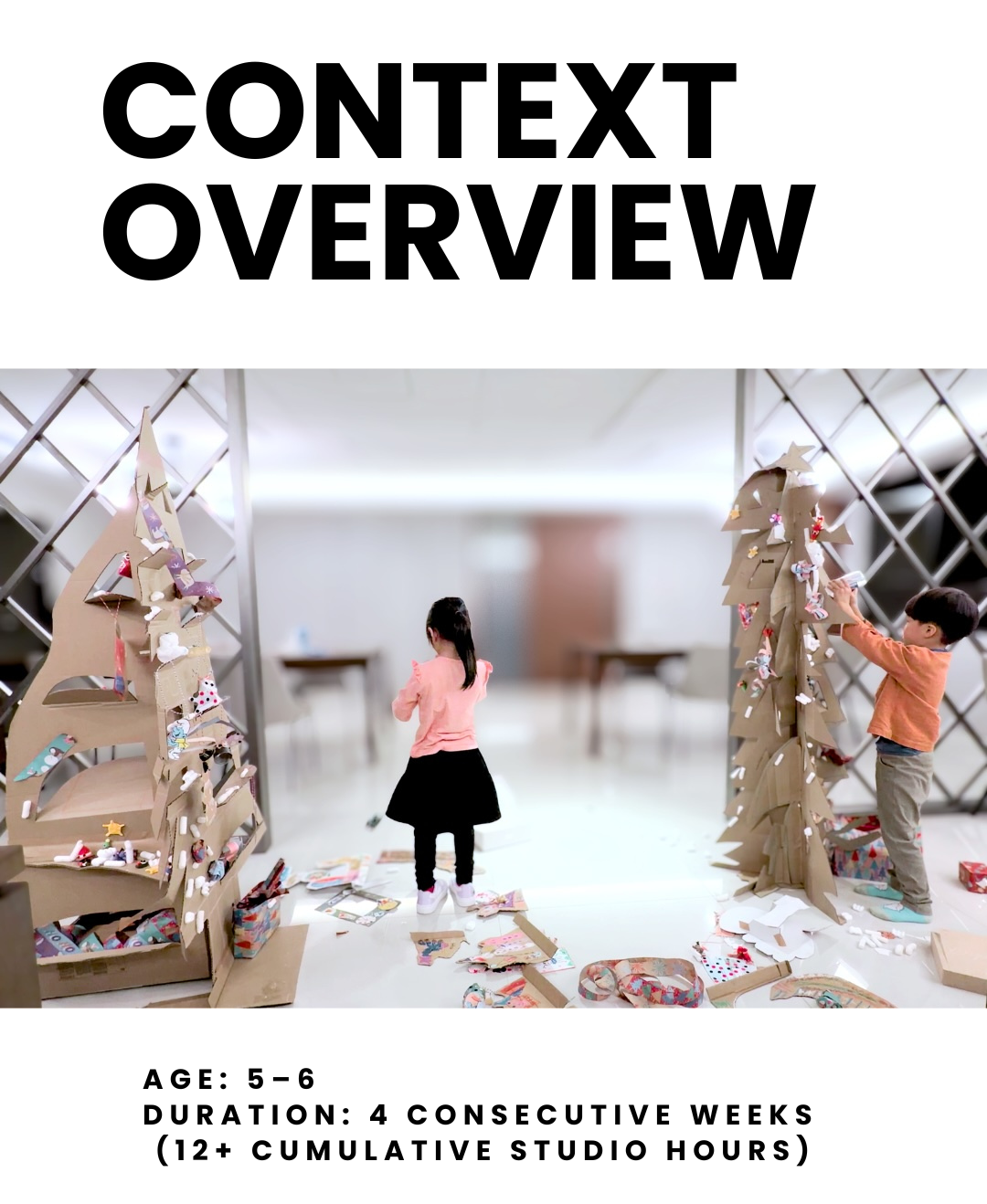
Learner age range: 5–6
Format: Multi-session, zero-screen, large-scale cardboard construction
Duration: 4 consecutive weeks, 12+ cumulative studio hours
Overview
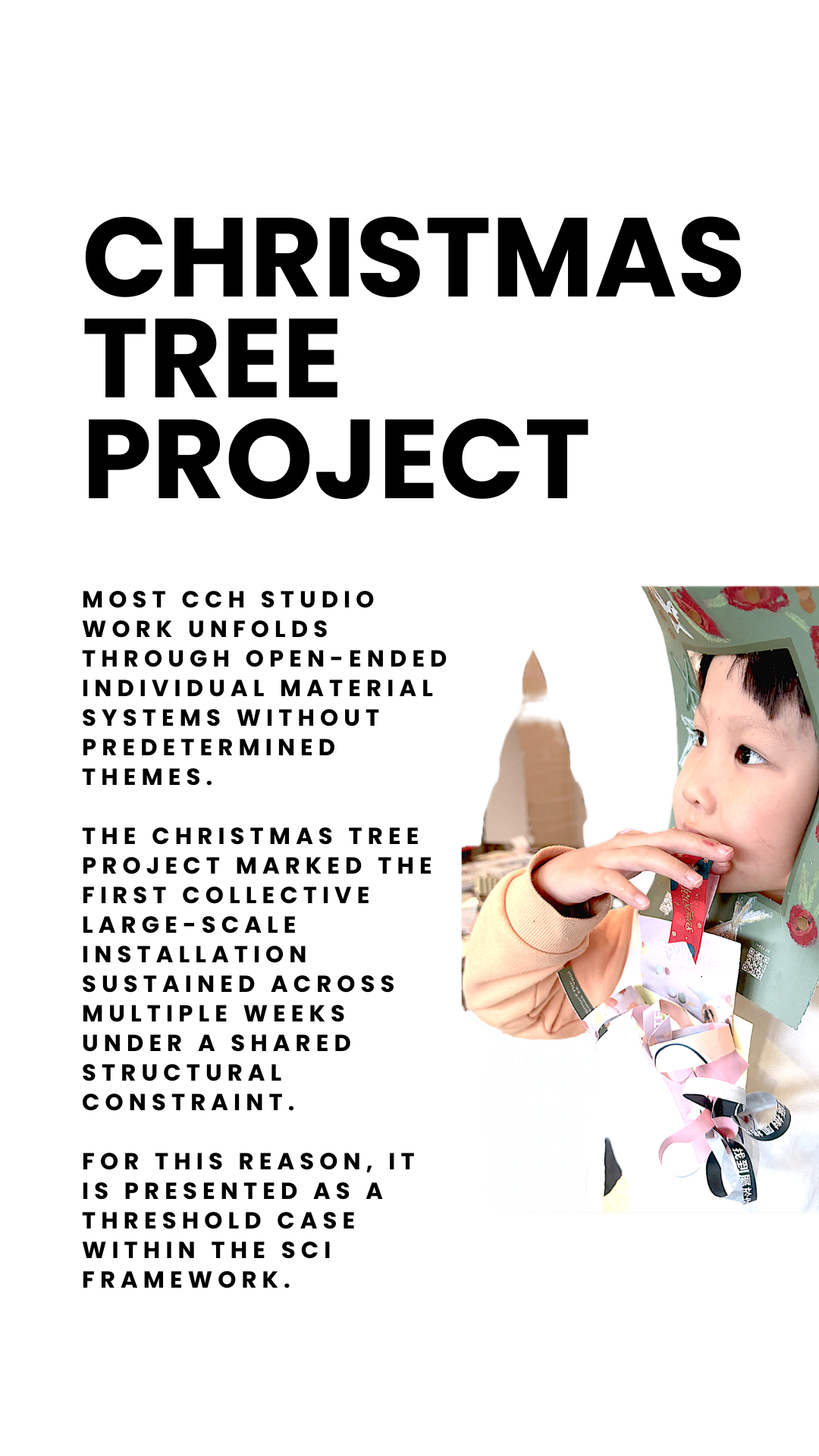
The Christmas Tree Project is presented as a threshold case within the CCH studio observation framework because it marked the first collective large-scale installation sustained across multiple weeks under a shared structural constraint.
Most CCH studio work unfolds through open-ended individual material systems without predetermined themes. In contrast, this project introduced a shared architectural premise: a vertical cardboard structure developed over time by young learners through drawing, cutting, attachment, reinforcement, decoration, and spatial decision-making.
The educational significance of this case does not rest on the final object alone. Rather, it lies in the extended process through which children remained engaged with scale, instability, material resistance, delayed completion, and cumulative structural consequence.
In this sense, the Christmas Tree Project functioned less as a seasonal craft activity and more as a studio-based test of temporal continuity, executive-function-related behavior, and embodied spatial reasoning.
Context and Project Format
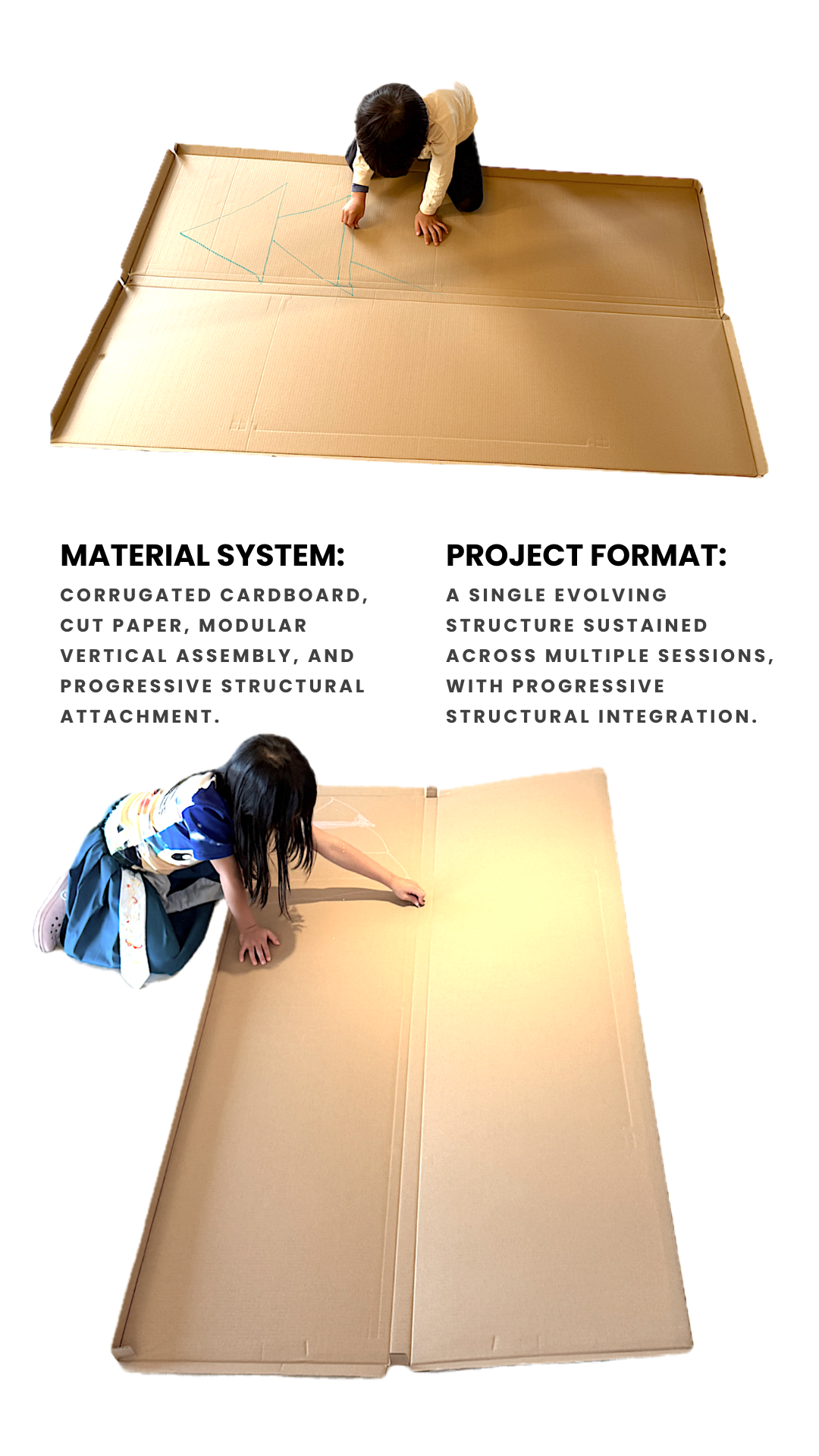
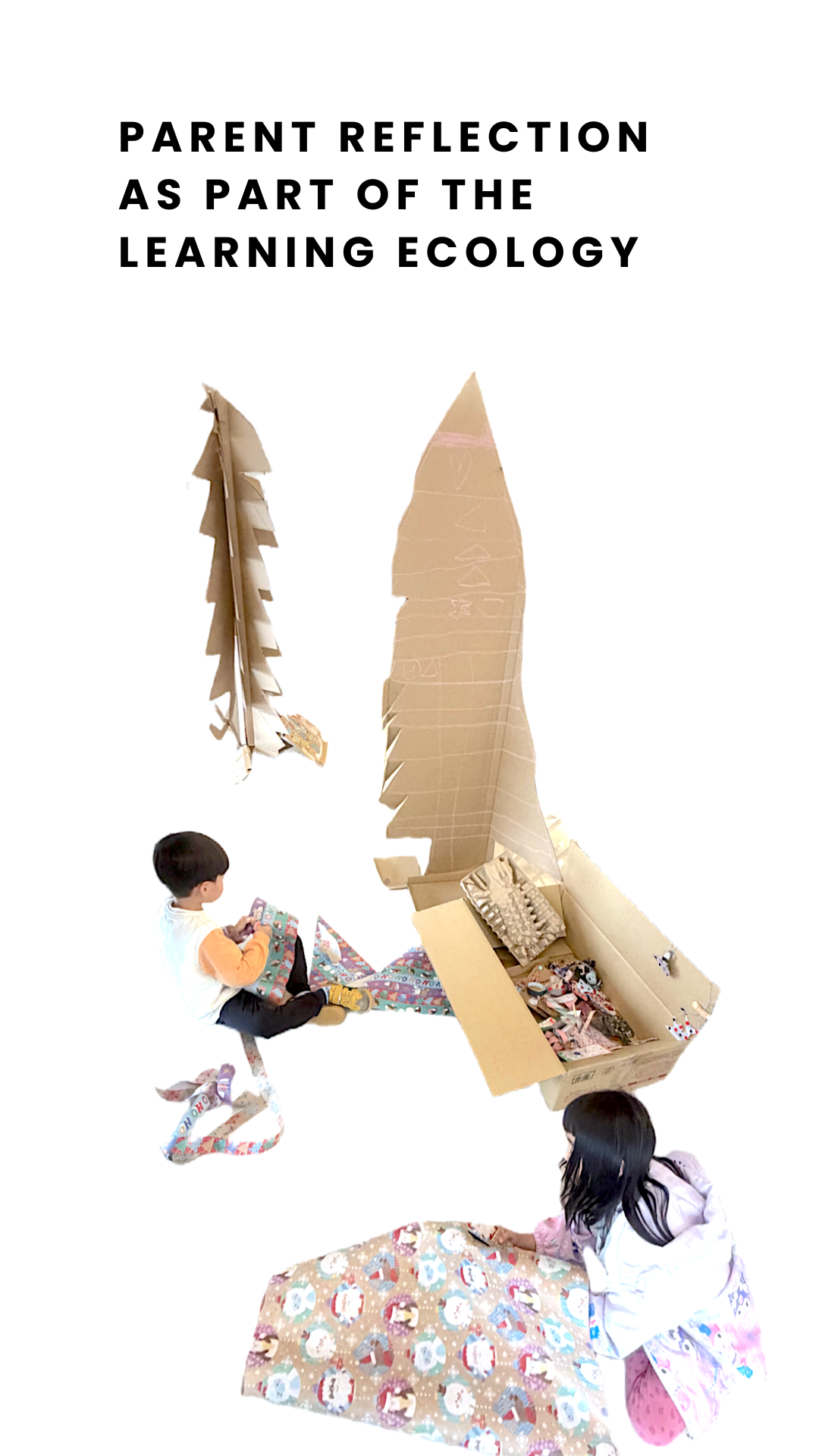
The project began with large corrugated cardboard surfaces placed directly on the floor. Learners first interacted with the material at body scale, using drawing and marking to initiate structural planning before the cardboard was cut, folded, assembled, and progressively transformed into vertical forms.
The material system included:
Corrugated cardboard
Cut paper
Modular vertical assembly
Progressive structural attachment
Open-ended decorative components
Repeated revision across sessions
The project format was intentionally cumulative. Rather than completing a small object within one short session, learners returned to the same evolving structure over multiple weeks. This continuity created a different type of cognitive demand: children had to remember prior decisions, respond to unfinished conditions, tolerate delay, and re-enter a project that did not reset at the beginning of each class.
This multi-week format contrasts with conventional early childhood task cycles, which are often shorter in duration and more outcome-oriented. Within CCH, the prolonged format allowed attention, responsibility, and structural thinking to become observable over time.
Structural Conditions
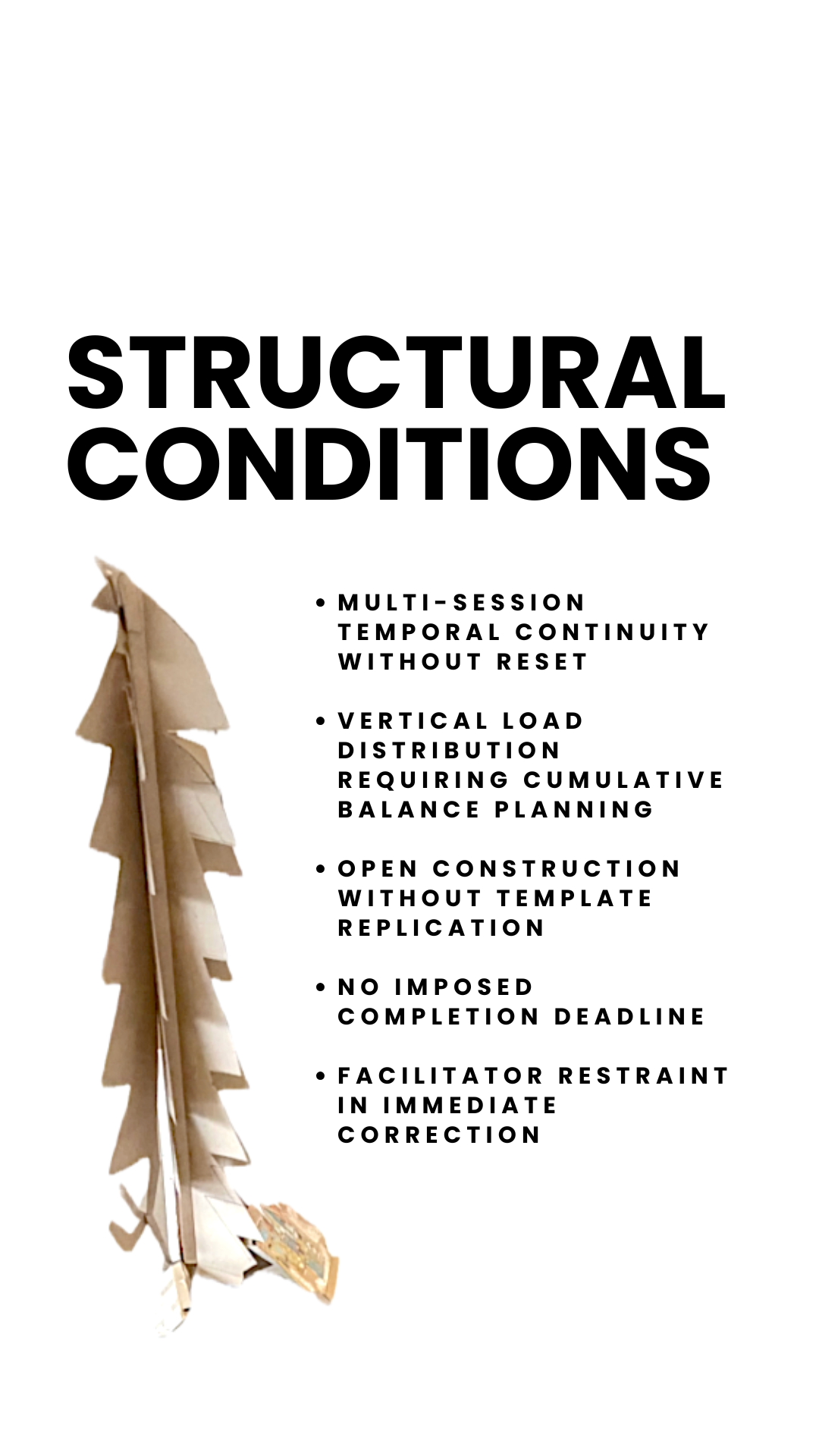
Several structural conditions shaped the learning environment:
Multi-session temporal continuity without reset
The project was not restarted each week. Learners encountered the consequences of earlier decisions and had to continue from an existing material state.Vertical load distribution requiring cumulative balance planning
As the cardboard forms moved from flat surfaces to upright structures, learners had to negotiate weight, height, attachment points, and instability.Open construction without template replication
The final structure was not copied from a model. Learners worked within a shared material constraint but made decisions through observation, testing, and adjustment.No imposed completion deadline within a single session
The absence of forced immediate closure allowed children to remain inside a developing process rather than rush toward a finished product.Facilitator restraint in immediate correction
The studio environment did not rely on constant adult correction. Instead, material consequence, visual comparison, and repeated handling allowed learners to perceive problems and participate in revision.
These conditions are central to the CCH approach. The educator does not simply provide materials; the educator constructs a learning ecology in which material resistance, time, and responsibility become part of the developmental environment.
Observed Behavioral Patterns
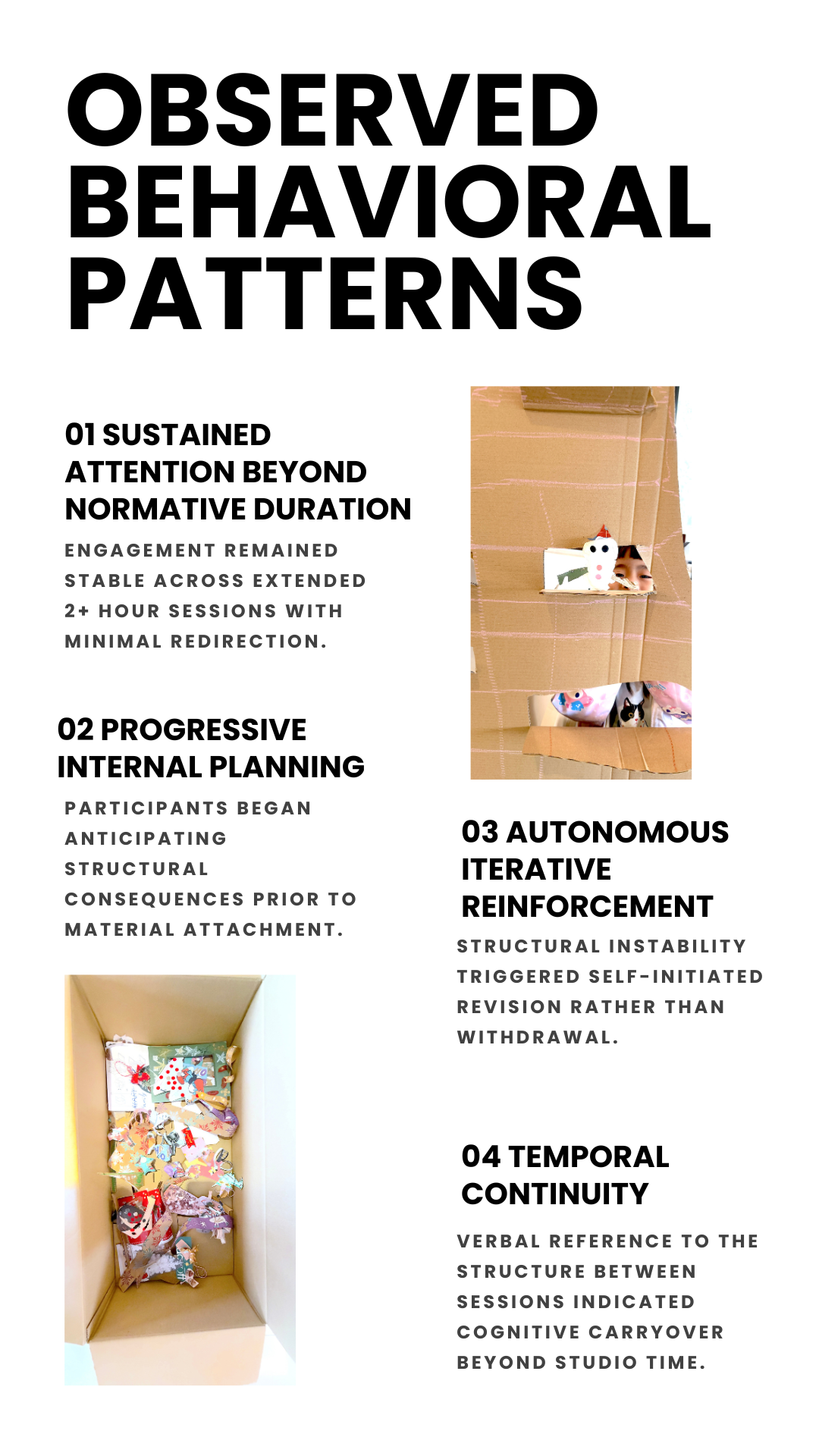
1. Sustained Attention Across Extended Duration
Across the project, engagement remained stable across sessions longer than typical short-form classroom tasks. Learners returned to the evolving structure, continued adding components, and remained responsive to the physical presence of the work.
This sustained attention was not passive endurance. It involved active monitoring: looking, adjusting, decorating, testing, and re-entering the material field after interruption or transition.
From a developmental perspective, this relates to executive-function capacities such as maintaining focus, holding an intention over time, resisting premature closure, and adapting behavior in response to changing task conditions.
2. Progressive Internal Planning
As the project developed vertically, children began anticipating structural consequences before material attachment. The cardboard could bend, collapse, lean, or fail to hold added pieces. These physical conditions required learners to consider sequence, position, balance, and future adjustment.
This planning did not appear as verbal explanation alone. It appeared through bodily positioning, repeated looking, hand placement, hesitation before attachment, and modification of earlier choices.
In CCH terms, this is significant because planning becomes embodied. The child does not merely think about structure abstractly; the child thinks through scale, weight, edge, fold, and resistance.
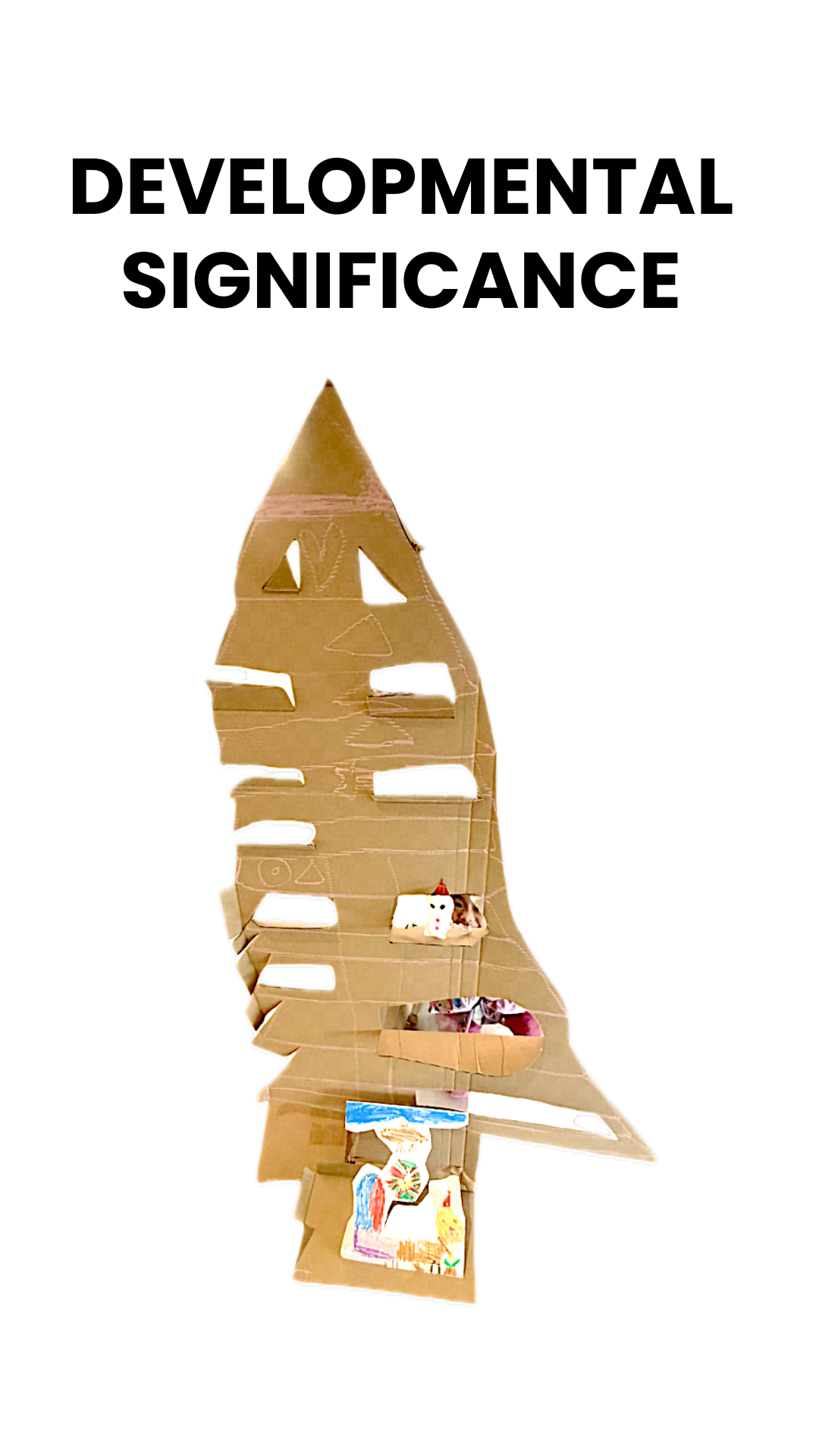
3. Autonomous Iterative Reinforcement
Structural instability triggered self-initiated revision rather than withdrawal. When elements failed, shifted, or required support, the project invited reinforcement. Children encountered failure as a material condition rather than as personal inadequacy.
This distinction is educationally important. In a non-competitive studio ecology, error can become information. The learner is not corrected into compliance; the learner is invited to observe consequence and adjust.
This behavioral pattern suggests the emergence of resilience through repeated low-stakes repair.
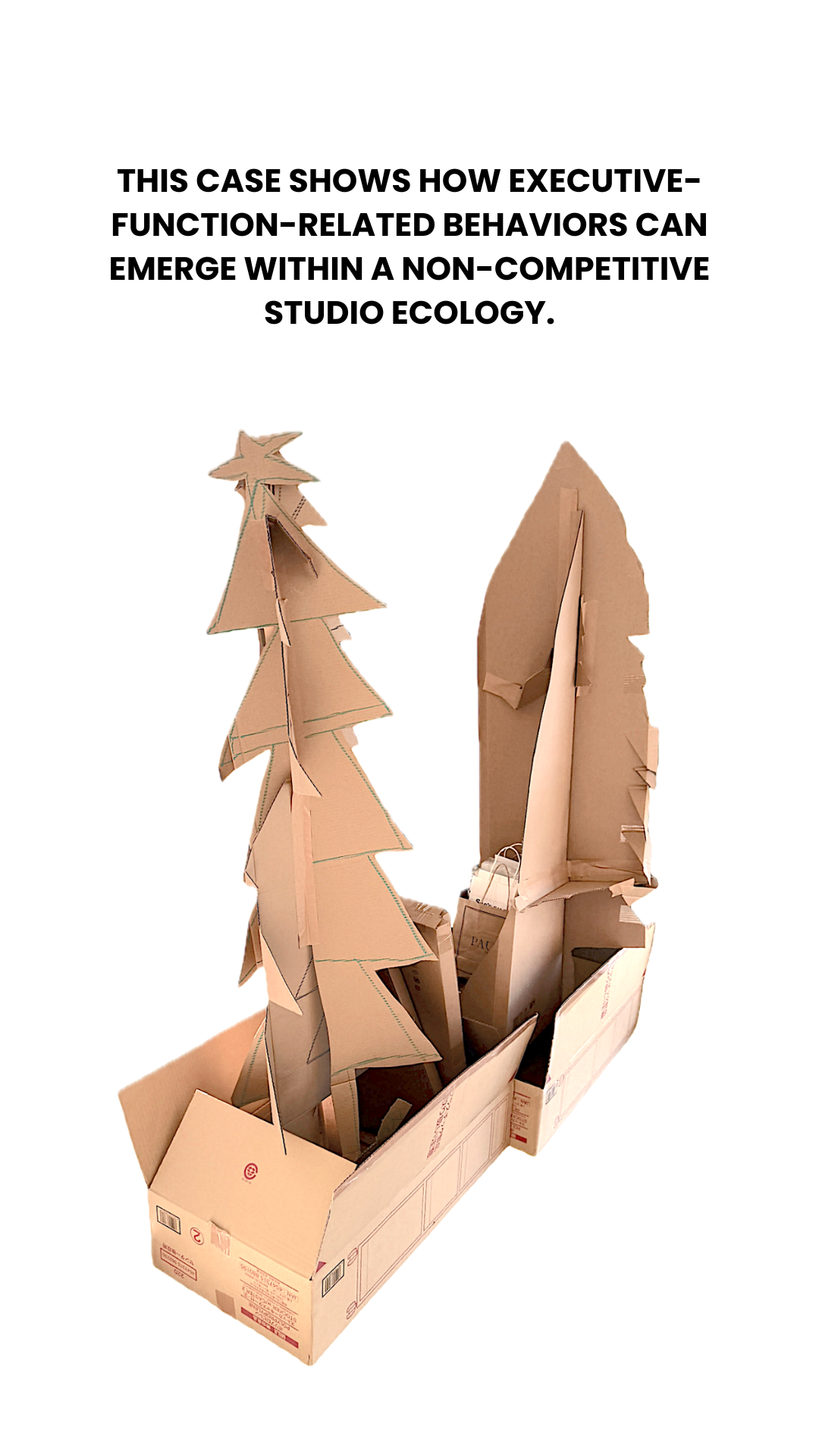
4. Temporal Carryover Between Sessions
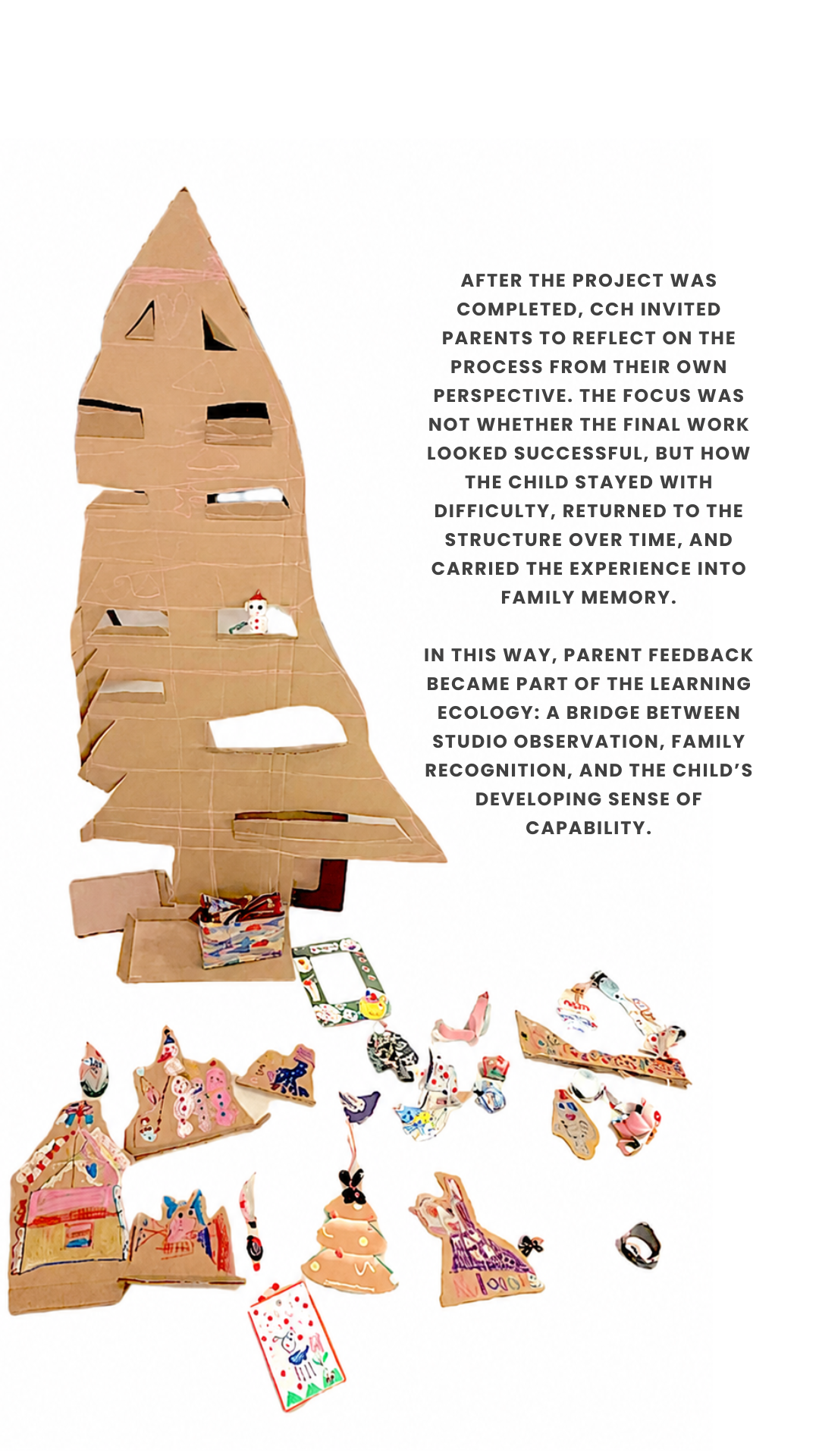
Children referred back to the structure between sessions and re-entered the project with memory of prior work. This indicated that the project was not experienced as an isolated class activity, but as an ongoing system.
Temporal carryover is important because it shows that learning was not confined to the moment of production. The project created a continuing mental object that learners could remember, anticipate, and re-engage.
Within CCH, this is one of the clearest signs that the studio condition has moved beyond entertainment. The work begins to occupy cognitive space over time.
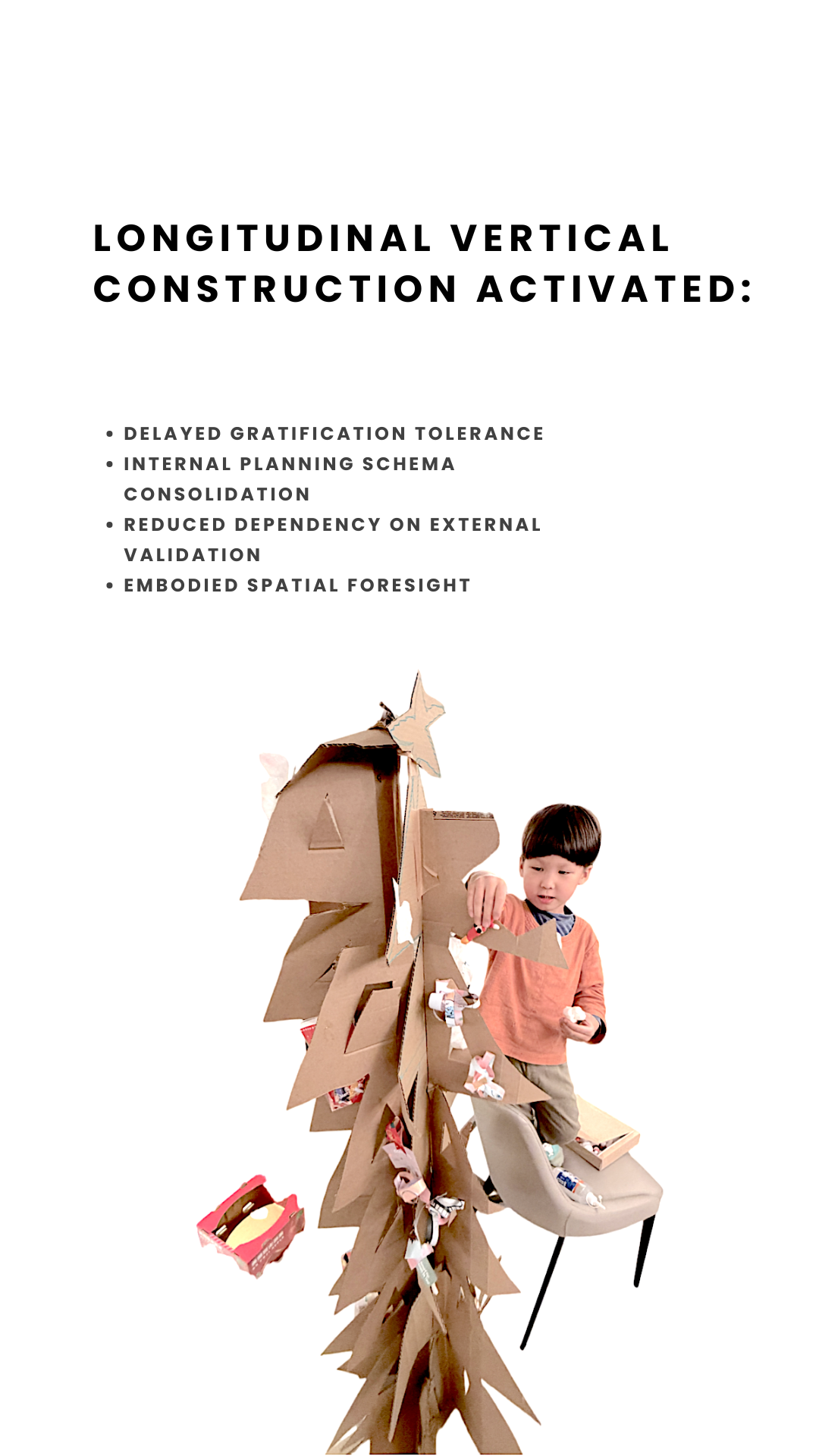
Developmental Significance
The Christmas Tree Project shows how executive-function-related behaviors can emerge within a non-competitive studio ecology.
The project activated:
Delayed gratification tolerance
Internal planning schema consolidation
Reduced dependency on external validation
Embodied spatial foresight
Revision after instability
Sustained engagement across time
Shared responsibility within a collective material system
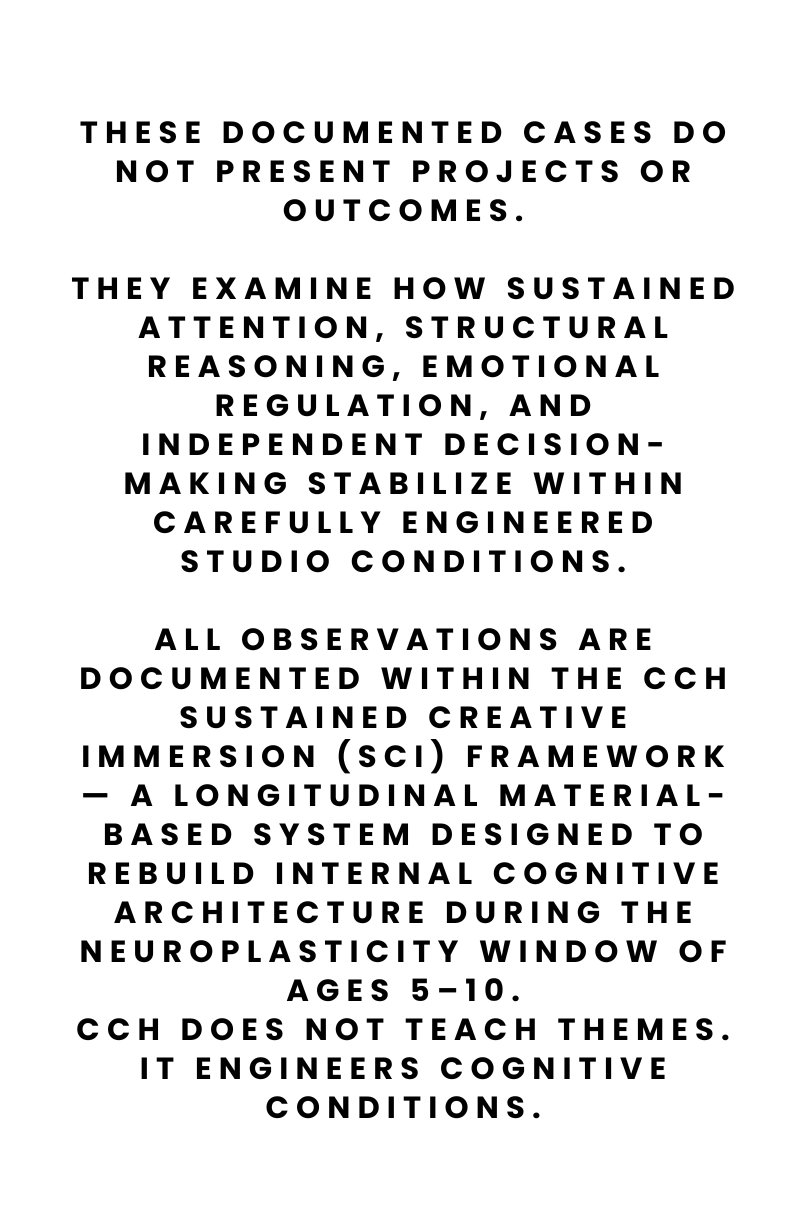
These capacities are not presented here as clinical outcomes or formal psychological measurements. Rather, they are documented as qualitative studio observations: visible behaviors occurring under carefully designed material, temporal, and social conditions.
The importance of this distinction is central. CCH does not claim that one project proves developmental transformation. Instead, this case shows how specific learning conditions can make developmental capacities observable.
Material Engagement and Cognitive Development
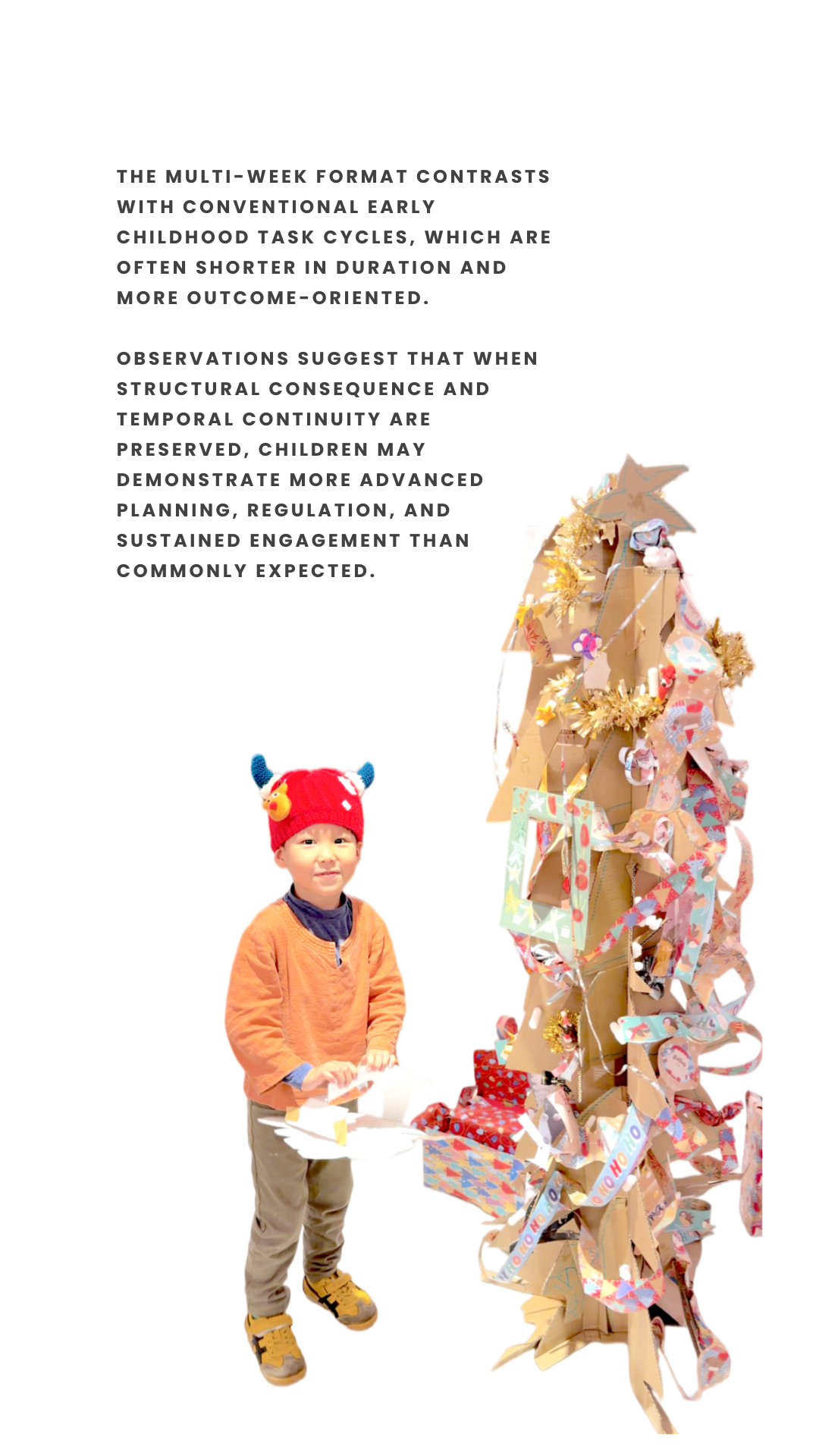
The Christmas Tree Project also demonstrates why material engagement matters in an AI-mediated world.
AI systems can accelerate production, generate visual outcomes, and reduce the time between prompt and result. However, the development of human attention requires conditions that cannot be reduced to output speed. Children need opportunities to encounter resistance, incompletion, instability, and consequence.
Cardboard, in this case, was not a neutral craft material. It acted as a cognitive partner. Its scale required bodily movement. Its instability required planning. Its resistance slowed action. Its verticality made consequence visible. Its unfinished state demanded return.
Through this process, the material system shaped the learner’s attention. The child’s thinking did not happen separately from the object; it emerged through handling, testing, attaching, revising, and returning.
This is why the project is important within the CCH framework. It demonstrates how a studio environment can function as structural infrastructure for cognitive stability.
CCH Interpretation
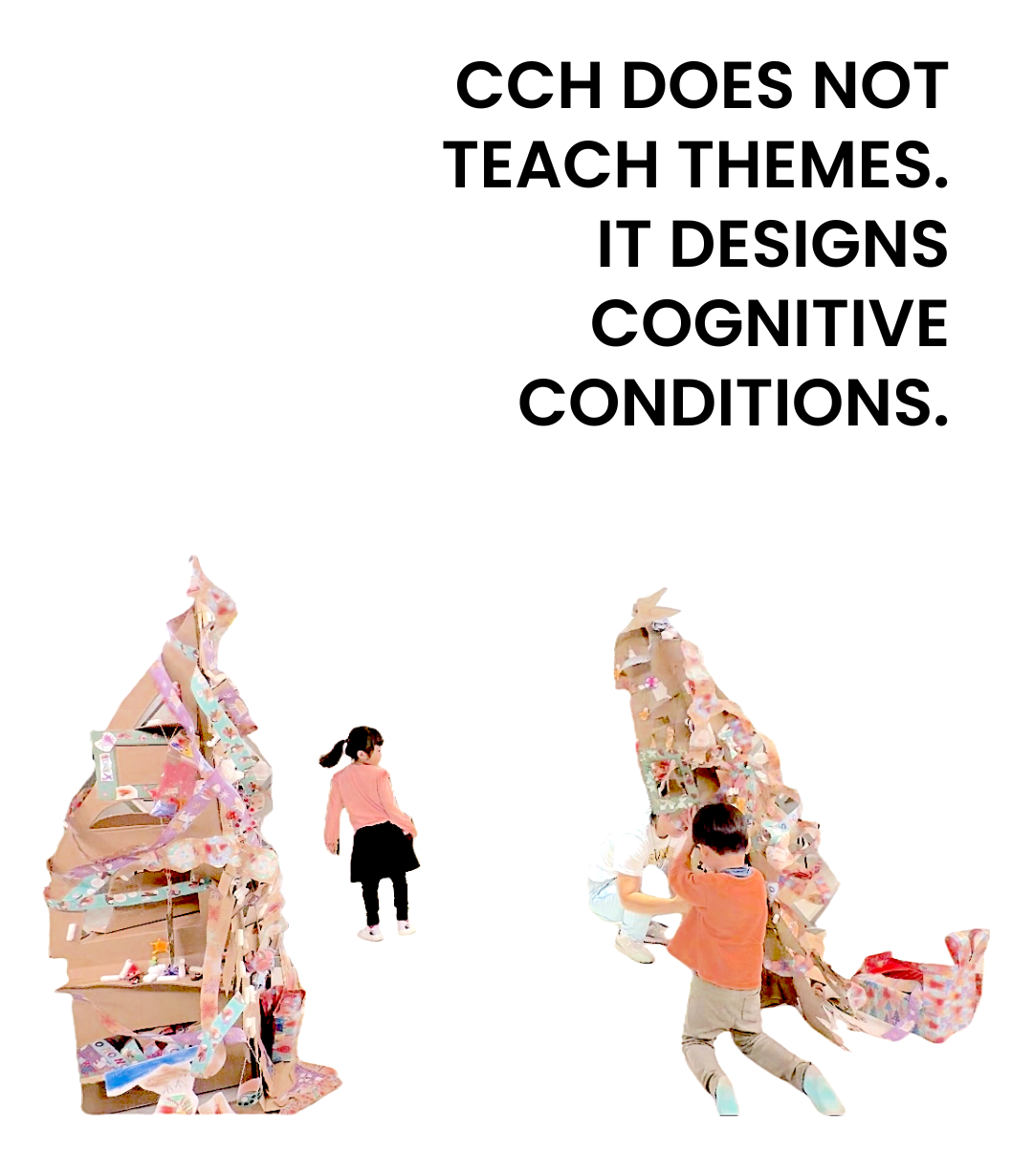
The Christmas Tree Project is significant because it demonstrates how young learners can remain engaged with a large-scale, open-ended, multi-session material system when the studio environment provides sufficient continuity, freedom, and structural constraint.
The project suggests that children are capable of more sustained engagement than conventional short-format activities often assume, especially when the learning environment does not over-direct, over-correct, or reduce the task to immediate output.
Within the CCH framework, this case supports three core claims:
Attention develops through designed conditions, not verbal instruction alone.
The environment must make sustained engagement possible.Material resistance can support cognitive resilience.
Instability, delay, and repair can become learning events.Long-duration studio practice can reveal forms of planning and agency that shorter tasks may not capture.
When the work continues across time, children begin to operate within a larger cognitive horizon.
Evidence Boundary
This article presents qualitative studio observation and parent-facing documentation. It is not a clinical assessment, psychological diagnosis, or completed third-party impact evaluation.
The observations should be understood as early evidence of process-based learning within CCH ART NOW™. Further documentation, independent review, and structured observation rubrics would strengthen the evidence base over time.
References
Diamond, A. (2013). Executive functions. Annual Review of Psychology, 64, 135–168.
Center on the Developing Child at Harvard University. (n.d.). A Guide to Executive Function.
Malafouris, L. (2013). How Things Shape the Mind: A Theory of Material Engagement. MIT Press.
OECD. (n.d.). Future of Education and Skills 2030/2040.
CCH ART NOW™. (2026). Learning Through Material Risk: WISE Evidence Brief. Parent feedback, studio observations, sustained attention records, and CCH-LFMA.